How I feel New Years Resolutions could be improved
Ah, the start of the new year. Time to think ahead to how THIS year will be the year when REAL change happen, and we GET SERIOUS about our money, health, productivity.
But if you are like most people (which as the tin says, most people are) our "new years resolutions" seem to fall pretty flat as the year goes on. What were yours at the start of last year?
I didn't complete mine either. At least, I wouldn't have, if I had been serious about setting any. If you are tired of New Years resoltuns that don't work, perhaps I can share a different avenue to change.
Tackling resolutions
Back in 2021, I was at rock bottom. I was in some severe old-man back pain, and was isolated at a desk during covid-19 completing university with no social contact. Life was... how could I put this eloquently?...
Shit.
Rather than the usual "get in better shape" or "make more time for myself" resolutions we make, I wanted to experiment with making things simpler. My "resolutions" became, for the month of January, for 30 days:
- Complete 20-30 minutes of yoga every day
- Read 1 page of a book every day.
What seems like such small resolutions turned into getting control back over my life.
Reading 1 page? Are you illiterate?
Yet, I set my aspirations small so I knew I could complete them, even at rock bottom.
Over the course of the following months, I
- learned how to hold a conversation in French for 10 minutes,
- practiced yoga every day for several months (I am a bendy boi and can do the splits),
- got back into physical training and became substantially stronger,
- read multiple books (okay 2... but that is technically multiple!),
And just felt like I had a huge sense of having my life back under control.
A different approach
I want to discuss why I think New Years Resolutions aren't useful for everyone, and can often be overwhelming and unclear as to what daily changes you make.
Instead, I am here to advocate for an alternative experiment:
- Instead of a lofty new years resolution or intricate plans, try a tiny 30-day new daily habit. One that is so laughably small that it's virtually impossible to not complete
I am not an expert at 'habit-building', 'self-development', or any other higher-conscious nonsense. I am undisciplined and lazy. And that's precisely why I feel i might be of use to you:
I found some simple things which worked for someone who is not an expert, which might be more relatable to the average person who may not as disciplined as our favourite god-like influencers.
I hope to convince you in the value of doing an experiemnt to build momentum as opposed to aiming for the unachaievable. If you want to make a change in the new year, and are tired of New Years Resolutions that don't work, I think I might provide some simpler, more actionable help.
This can be split into 3 steps:
1. Focus on a behaviour
2. Make it impossibly easy
3. Track it
Let's do our best not to overcomplicate things.
Focus on a behaviour
You may have a resolution
- getting in shape,
- having control over finances,
- be more productive,
Most importantly, stop shouting at (1) people on the street (2) your parents, and (3) that smug, conniving reflection staring back at you in the mirror.
Seriously who does he think he is?
Here's a suggestion: rather than keep this as a large over-arching resolution, try translating how that would look as a behaviour you actually do.
Preferably, what does that look like on a day-to-day basis?
If unsure, it can be helpful to think...
1. "What is the person I want to become?"
2. "What would that person do every day?"
For instance:
PERSON: Become a writer online (what inception is this?); HABIT: Write every day
PERSON: Be in better shape and lose some weight; HABIT: someone who works out every day
PERSON: Be a calmer person who stops themselves from losing their shit with their parents and at the back of people's cars in traffic; HABIT: That person might make some space with meditation.
This is simply to become clear on how you actually move towards, on a daily basis, to a better place. A daily behaviour is the start of an action plan. By specifying the behaviour, we identify the habits that we want to build.
James Clear, habit expert and author of atomic habits, said in a recent interview with Tim Ferris:
Our results are a lagging measure of our daily habits
Whatever we want to become, including the results we want, we can try translating that into daily action. Over time, after completing something everyday, we start to become that writer, that voracious reader, that gym-shark athlete, the calmness amoung the storm. It starts with what you do every day, not infrequent mass pushes.
we are still dealing in the lofty, undefined realms that resolutions tend to operate.
A further step towards the peak human beings we are going to become is to specify how much we will do that behavior so we have a concrete metric.
- How many words a day will you write?
- How much will you work out?
- How much will you meditate?
- How many existential questions will you avoid?
Now, I would be the first person to crack the proverbial whip at myself to ramp up the intensity of working out for 2 hours a day, meditating for 3, and writing a book, before 2pm.
I'll be the first to admit, this rarely works. At least, not for more than a week once that intensity becomes unsustainable. This is useful for getting some immediate results yet isn't for sustaining a habit over the long term. Consistency over months and years, instead of sporadic spurts and plops, leads to real results.
I've found aiming incredibly small to some tiny, seemingly inconsequential amount, at least in the beginning, can have remarkable power.
Make it as easy as possible
The power of 1 page
When I started out reading, I knew could probably read about 10 pages of a book. How long does that take? 20 minutes? Pfffft. 20 minutes! Of course, I can give 20 minutes a day. I have 24 hours.
Child's play.
Having tried this before, it failed after a week. Then back to zero reading. Instead, I aimed to read every day so I could build the habit of reading, and then scale up.
So I thought, on my worst day, what would I be able to do?
After finishing a punishing day of university, being exhausted, stressed, and full of self-loathing, was I about to spend 20 minutes before bed reading a productivity book? I think I'd have rather used the book as a weapon.
I opted for 1 page. 1 page a day. I could read more if I wanted, but just 1 page, with the goal of not missing a day in a month.
However, each day that I read and crossed off another day, I cast a vote to myself that I was someone who was a reader. And each day, the routine of reading became easier.
Of course, I missed a day or 2 in the month. Surprise; I couldn't even follow my own advice. Evidently, that single page was sometimes too overwhelming.
But, after the month ended, I scaled up to 2 pages, and after that month, 5. Soon enough, I was reading hundreds of pages a month. It was only possible because I had sought to establish the habit of reading, in a sustainable way, that I could end up reading and finishing books. Reading became a standard part of the day, instead of an infrequent "must-do."
Over the course of months, and perhaps years, taking tiny steps like these can contribute to the development of habits that move us in the direction we want. We may not do loads in the beginning, but focusing on building momentum allows the habit to stick over the long-run.
That's where the magic jewels are.
Your worst day
Each day you complete your desired behaviour, you cast votes towards your identity as the new person you want to become. The point is to build the habit of showing up.
In the beginning, you can try setting your expectations exceedingly low. Aim for something that takes 1-2 minute maximum so that you know you can complete it each day. Focusing on the smallest amount possible means you cannot fail. Rather than wanting purely results, this is immensely helpful for building momentum
When thinking about how much to aim for, ask the question "could I do this on my very worst day?" When that very worst day comes, which might be more often than we expect, you are still keeping on track and proviing to yourself you can keep the habit
Once you prove to yourself that you can show up every day, then increase how much you do. Master consistency first, then focus on proficiency.
Summary
This impossibly small commitment is where I feel there is a difference between the usual resolutions:
- You start to build momentum every day, which can then continue on for months to come as you increase how much you do, all the while focusing just on showing up.
- The easiest way of doing that is making the habit as small as it can be, so it's effortless to do.
- As time goes on, you start to see bigger changes. Before you know it you are becoming a person who works out for an hour every day.
- and it all started because you focused on consistency in the beginning, to build a foundation for the future.
Track it
All we really need is consistency and showing up in a small way every day. However, to support this, I found keeping score by tracking my consitency to be incredibly useful, in 2 ways to:
- Remind
- Keep the streak
Remind
Here's a something similar to what I printed off which I used to cross off each day I completed my habit, be it exercise, reading, or writing. Each day I read 1 page, I crossed an X on that day.
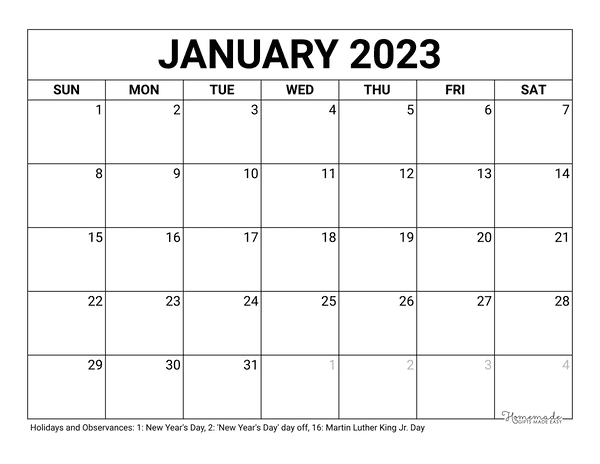
It has the characteristics of some of my posts: plain, simple, and boring.
I had it pinned right where I would be reading my book, in a specific chair. When I was exhausted and ready to clamber into bed, there stood my arch nemesis staring back at me in the face, with an empty X for that day...
The tracker.
Upon seeing this, some deeply concerning profanity would come out and that would probably prevent me from getting any job in the future if I posted it here. But it was a physical reminder that even my most fatigued brain could detect, which ensured I didn't forget to just keep up the momentum.
And then I read the page and went to bed.
I suggest supporting yourself with a simple tracker in an obvious place where you might do the habit - it can also be digital on various apps as I have done before. But having a reminder is most powerful on those days you least want to do it - and those are the days where you most need to stay on the ball.
To keep the streak
As I started to see the days add up, especially once I was about 14 days in, things started to happen.
Had I grown my second brain by this point and learned how to levitate?
No, of course not. You think I couldn't already do that?
Nevertheless, I probably wasn't even through the second chapter of my book and with the same knowledge I had already had. But, I had a feeling:
Fuck yeah, look at that. I'm doing it! I'm reading every day!
It was physical evidence that I was becoming the person I wanted to be. Hard to tell yourself you're not someone getting in shape when you have evidence of working out for 14 days straight
Using a visual reminder shows you the person you are becoming with evidence. You can leverage your favorite self-hatred by not wanting to disappoint and break that streak. It becomes a source of pride to want to keep going. You get so far in, and you don't want to miss a day.
Conclusion
Do we end the month doing this having evolved to a next stage of human evolution? No. We don't finish a month with much other than a few X's on a piece of paper. But, that's precisely why you would do this. I'm astounded at how focusing on showing u every day in some seemingly innocuous way can have such a large knock-on effect throughout the rest of your life.
The value of showing up daily is so it has a ripple effect to carry you forward - it's to change your belief of yourself without any bullshit "mindset" or "unconscious brain insertion hacking" techniques fluttered at us online. You change how you view yourself with your action.
We don't need to move mountains. But we might get to be that person we want by lowering the bar and trying to take consistent steps in that direction.
Maybe don't through New Years Resolutions out the window. We still need a story. who am I to tell you otherwise?
Showing up every day in a tiny way helped me do the things I wanted to do and had a knock-on effect for the rest of my life. If you are bored of new years resolutions and feel you might want to try something better, it might for you too.
What have you got to lose? It only takes a minute a day.